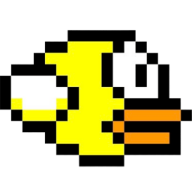
THE CORE LOOP
How does Flappy Bird work?
Flappy Bird is built around one repeated decision: tap now or wait? Each tap gives the bird a short upward push. Between taps, gravity steadily lowers it. The player must balance those two forces while the pipes move from right to left.
The controls are minimal, but the movement has momentum. Tapping too early can send the bird into the top pipe; tapping too late can leave too little time to climb. Because every mistake immediately ends the run, players quickly understand what went wrong and usually want to try again.
A SHORT HISTORY
Who created Flappy Bird?
Flappy Bird was created by Vietnamese independent developer Dong Nguyen and released for iOS in May 2013. An Android version followed in early 2014. The game attracted limited attention at first, then rose rapidly through app-store rankings at the end of 2013 and beginning of 2014.
Its sudden popularity made the tiny game a global story. Players posted scores, reactions and failure videos across social media, while friends challenged one another to beat seemingly modest totals. The game became recognizable even to people who had never downloaded it.
Flappy Bird launches on iOS.
The game climbs to the top of free-app charts and becomes a viral phenomenon.
Dong Nguyen removes the original app from major app stores.
The basic tap-to-fly idea continues through browser recreations and games inspired by it.
WHY IT SPREAD
Why did Flappy Bird become so popular?
There was no single reason. Several design and cultural factors reinforced one another:
- Instant understanding: players could learn the goal in seconds.
- Short sessions: a failed run often lasted only moments, so restarting felt effortless.
- Visible scores: one number made competition between friends simple.
- Near misses: failing beside a pipe made success feel achievable on the next attempt.
- Shareable frustration: surprising difficulty generated reactions, jokes and videos.
- Retro presentation: the pixel-art look was readable on small phone screens and easy to recognize.
The result was a compact game that worked equally well as a private time-killer and a public score challenge.
SIMPLE IS NOT EASY
Why is Flappy Bird so difficult?
The bird never stays still. Every flap changes its vertical speed, and gravity immediately begins pulling it back down. This means the player is not moving directly to a chosen position; they are constantly correcting a moving trajectory.
The pipe openings also punish large corrections. A rapid series of taps may save a falling bird but create too much upward momentum for the next gap. Successful play usually looks calmer than unsuccessful play: small, regular taps and early adjustments are more reliable than panic tapping.
THE 2014 REMOVAL
Why was Flappy Bird removed?
Dong Nguyen voluntarily removed the original game from the Apple App Store and Google Play in February 2014, when it was near the height of its popularity. In contemporary interviews and statements, he described the pressure created by its unexpected success and expressed concern about players overusing the game.
Nguyen denied that legal action forced the removal. Phones that already had the app installed could continue running it, but new users could no longer obtain the original version through the major stores. That scarcity helped turn the game from a temporary hit into a lasting piece of mobile-game history.
PLAYING TODAY
Can you still play Flappy Bird?
The original 2013 mobile release is not generally available as a new download from the major app stores. However, the central game idea has been recreated many times for browsers and other platforms.
This website offers an independent browser game inspired by the familiar one-button pipe-flying format. It is not the original mobile application and is not affiliated with Dong Nguyen or dotGears. You can play it free in your browser without installing an app or creating an account.
LASTING INFLUENCE
Why does Flappy Bird still matter?
Flappy Bird demonstrated that a small game could reach a worldwide audience without cinematic graphics, a long campaign or a large development team. Its influence can be seen in countless one-button games, score-chasing challenges and browser recreations.
More importantly, it remains a clear example of focused game design. The rules, controls, scoring and failure state all support the same central skill: timing a flap. That clarity is why the game is still immediately recognizable years after its brief period at the top of the app charts. If you have seen conflicting high-score claims, read our evidence-based explanation of the Flappy Bird world record.